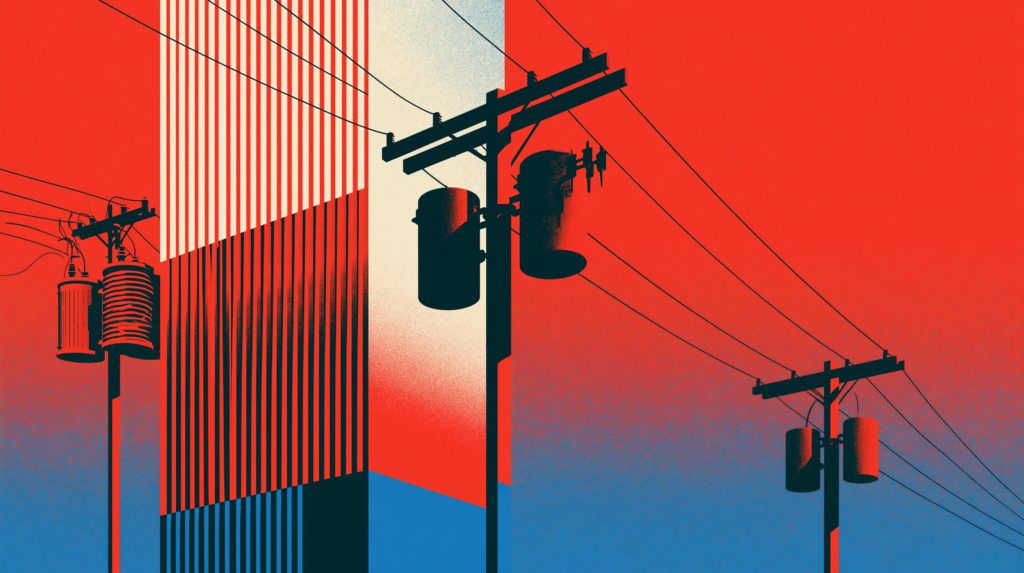

The Frontier Scenario: A Year in the Life of Unicorn AI
Welcome to The Frontier Scenario, an illustrative, fictional account of frontier AI development and how ARI’s Blueprint for Frontier AI Governance could be applied to address AI risks.

Across the country, data centers are quietly reshaping electric grids, with the Lawrence Berkeley National Lab projecting that data center electricity consumption will rise from 4.4 to 6.7–12 percent of total U.S. demand by 2028. As utilities build the supporting infrastructure this surge requires, their forecasters are confronting new uncertainties.
Data center operators are not subject to standardized reporting of their electricity consumption, efficiency gains, or on-site generation. As a result, analysts, grid planners, and policymakers are left without the data they need to make accurate predictions and mitigate risks. Meanwhile, communities sit downstream, absorbing the impacts of new buildouts.
A similar problem emerged in the 1970s. Following two decades of electricity use growing in step with industrial and economic expansion, utilities and regulators invested in new infrastructure, assuming the trend would hold. But “assumption drag” (failure to incorporate new information into forecasts) clouded their models: forecasters overlooked slowing GDP growth, industrial change, conservation, and rising energy costs. Utilities committed billions of dollars to meet demand that did not materialize, leaving them with stranded assets and overcapacity. Those costs were borne by electricity customers.
A Forecasting Failure, Repeating
Grid operators are already being blindsided by load behavior. In Virginia, when 60 data centers simultaneously switched to backup generators after a voltage fluctuation, the sudden load drop forced operators to urgently scale back power plants to prevent wider outages. The Electric Reliability Council of Texas (ERCOT) also experienced a load reduction of approximately 1,500 megawatts as hundreds of loads reduced demand during a low-voltage period.
On May 4, 2026, the North American Electric Reliability Corporation (NERC) issued a Level 3 grid alert (the reliability watchdog’s highest level), citing computational loads as a direct threat to grid stability. NERC found that its registered entities “generally did not have sufficient processes, procedures, or methods to address risks associated with computational loads,” acknowledging, plainly, that grid entities lack the information they need to maintain stability for everyday consumers.
In the face of grid uncertainty, energy analysts need to know what’s coming. But without standardized, facility-level data, their models lack essential information for accurate predictions.
The disclosure problem starts with aggregation. Most hyperscalers disclose consumption as a company-wide aggregate, meaning companies like Amazon can lump data center electricity use with that of grocery stores and warehouses into one figure. A 2024 study found that, among thirteen major AI data center operators examined, only one publicly disclosed the scale of its AI hardware electricity use. Only two regularly reported data center operations separately from other company activity.
Reporting in the Dark
In addition, AI data center load profiles are distinct from those of traditional data centers. First, their servers run on high-power hardware, driving intensive cooling and, therefore, electricity needs. Second, AI computations have varying load profiles: training workloads produce rapid demand fluctuations, spiking or dropping in under one second; inference workloads are more stable, but shift with user activity. Modeling this behavior requires data disaggregated by workload type.
Researchers do what they can, using bottom-up, top-down, and extrapolation methods to estimate data center electricity use. However, each approach depends on the accuracy of its underlying consumption data, and that data is scarce. The result? Because data center operators don’t disaggregate reported information, analysts can’t gauge how technology innovations could shift overall demand. Utilities are left making infrastructure investments without a comprehensive national inventory of load data.
The uncertainty costs everyone. Over-forecasting ties up capital in overcapacity and stranded assets; under-forecasting brings shortages, emergency purchases, and reliability issues. Communities are the most likely candidates to bear the costs of this uncertainty, sometimes literally.
Energy forecasts rest on another unknown: how efficiency varies from facility to facility and how efficiency gains might ripple into national demand projections.
Most data center operators measure efficiency in-house, reporting only select figures. Many facilities also rely on power usage effectiveness (PUE), which measures the efficiency of supporting infrastructure such as cooling and lighting. But PUE does not measure the efficiency of IT and related equipment, which account for 60-95 percent of data centers’ total electricity use. Metrics such as IT usage effectiveness (ITUE) and IT work capacity (ITWC) can shed more light on how efficiently data center hardware uses electricity. But these have seen little industry uptake, leaving efficiency gains opaque to consumers and analysts. Greater transparency would prevent utilities and analysts from over-forecasting buildouts and sticking communities with the bill.
Where a Data Center’s Power Goes
As new data center construction timelines outpace those of grid infrastructure, developers are bringing their own generation, including on-site gas turbines, batteries, and diesel generators. These run with little public visibility and carry costs: air pollutants and round-the-clock noise.
In South Memphis, the xAI Colossus campus maintained 20 unpermitted gas turbines and exceeded its permitted capacity. The nearby 79 percent spike in peak nitrogen dioxide levels surfaced only after residents reported gas smells, and civil society members and journalists commissioned their own analysis.
Without visibility into these sources, policymakers and communities have little insight into how data centers are powered across the country, or the externalities they may impose on surrounding areas. Professor Shaolei Ren of the University of California, Riverside, notes that developers can report “whatever they choose, however they choose, about their AI impact.” A reporting mandate would put this generation on record, disclosing which sources developers actually use.
The 2027 Energy and Water Appropriations Act is taking a step toward addressing these impacts. The measure, which passed out of Committee in May, would advise the Department of Energy (DOE) to “identify and mitigate” data center impacts on energy, grid reliability, transmission and distribution, and ratepayers. It would also direct DOE to evaluate technologies and operational strategies that could increase the facilities’ energy efficiency.
For the DOE to mitigate these impacts, they must be equipped with the tools to identify them. The Appropriations Act takes a step in this direction, with report language directing the Energy Information Administration (EIA) to develop a proposal to collect information on data center consumption.
These are good first steps, but the time for mandatory reporting standards is now. The EIA is already running voluntary pilot surveys in Texas, Washington state, and Northern Virginia to gather disaggregated data from hyperscalers. The EIA Administrator has also signaled his intent to launch a nationwide survey. The framework exists; what is missing is a mandate.
Congress should require the EIA to establish a standardized, mandatory reporting framework for data center electricity consumption, which covers the full stack, from on-site generation to IT equipment to cooling systems. In parallel, the Federal Energy Regulatory Commission (FERC) and NERC should require large loads to register under their reliability standards to derive real-time consumption profiles and simulation data.
In the 1970s, forecasters extrapolated a trend that quietly stopped holding, utilities sank billions into capacity, and everyday customers covered the bill.
The difference now is that the information needed is not unknowable. It is just unreported.

Welcome to The Frontier Scenario, an illustrative, fictional account of frontier AI development and how ARI’s Blueprint for Frontier AI Governance could be applied to address AI risks.
The controversial U.S. spy program–FISA Section 702–expired over two months ago. Without a deadline pressuring a clean reauthorization, Congress has a moment to address the loopholes that allow warrantless surveillance of Americans.

Not only can assurance science help analyze and prevent such crises, but it could also contribute to critical long-form analysis of model behaviors, pinpointing when and why AI models take unwanted actions, allowing for targeting additional safeguards.